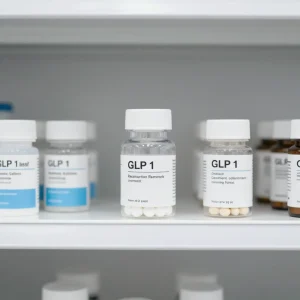


GLP-1 medicines (like semaglutide) can help people lose weight by reducing appetite, increasing fullness, and improving metabolic signals that influence eating behaviour. But weight loss with GLP-1s isn’t “instant”, and it isn’t identical for everyone.
This blog sets realistic expectations: what typical results look like in clinical trials, how timelines usually play out, what factors change outcomes, why plateaus happen, and what “success” should actually mean beyond the weighing scale.
Educational note: This is general information, not medical advice. Eligibility and safety decisions should be made with a clinician.
The big picture: what “average weight loss” looks like
When people ask, “How much weight will I lose on semaglutide?”, the most honest answer is:
Most eligible adults lose a meaningful amount of weight, often in the 10–15% range over about 1 year, when the medication is combined with lifestyle changes. In the STEP-1 trial (adults with obesity/overweight without diabetes), average weight loss at 68 weeks was ~14.9% with semaglutide 2.4 mg vs ~2.4% with placebo.
For people with type 2 diabetes, the average weight loss can be lower than in non-diabetic obesity trials (because diabetes, insulin use, and metabolic factors can influence outcomes). One semaglutide study in adults with type 2 diabetes reported ~9.6% mean loss at 68 weeks at 2.4 mg.
What this means in simple math
- If you weigh 100 kg, a 10–15% loss is roughly 10–15 kg
- If you weigh 80 kg, a 10–15% loss is roughly 8–12 kg
Some people lose more, some less. Your starting weight, insulin resistance, sleep, stress, strength training, protein intake, and consistency all matter.
Timeline: when you’ll start seeing changes
Weeks 1–8: early appetite shift, small-scale movement
Most people start on a low dose and gradually increase the dose to reduce GI side effects. Dose escalation commonly runs over ~16 weeks before reaching the maintenance dose.
In the first few weeks:
- Appetite and cravings may reduce
- Portions naturally get smaller
- Weight loss may be modest (and sometimes noisy due to water changes)
Weeks 8–16: momentum builds (but don’t rush the dose)
As the dose increases, weight loss often becomes more noticeable. But this is also when nausea/constipation can show up if meals become too large or too fatty.
Months 4–12: the “real” fat-loss phase
Most of the meaningful, sustained change typically happens across months, not days.
Clinical trials measure outcomes around ~68–72 weeks, showing the full effect of consistent treatment + lifestyle support.
“Why is my friend losing faster than I am?” The 7 biggest reasons results vary
- Diabetes status & medicines
People with diabetes may see different weight trajectories (and insulin/sulfonylureas can complicate weight loss). - Dose and adherence
Not everyone reaches or stays on the full dose due to side effects or supply/cost issues. - Protein + strength training (muscle preservation)
If you lose weight without strength training and adequate protein, you can lose more lean mass than you want. A body-composition study in tirzepatide showed weight loss included both fat and lean mass changes, highlighting why resistance training matters. - Sleep & stress
Poor sleep increases hunger signals and reduces consistency. GLP-1 can help, but it doesn’t fully override biology. - Under-eating / irregular eating
This sounds strange, but very low intake can backfire, cause fatigue, low protein, cravings later, and poor adherence. - Alcohol & liquid calories
Even with reduced hunger, liquid calories sneak through easily. - PCOS / insulin resistance
Weight loss may be slower for some with PCOS and high insulin resistance, but many still benefit, just with more emphasis on strength training, protein, and consistent tracking.
What “good progress” looks like (beyond the scale)
If you’re only measuring success as “kg lost,” you’ll miss half the wins. Clinically, “good progress” can look like:
- Waist circumference reducing
- Better fasting glucose / HbA1c (especially for diabetes/prediabetes)
- Improved blood pressure and lipids
- Less snacking, fewer cravings, better satiety
- Better energy and sleep consistency
Plateaus: why they happen and what to do
A plateau is common after the initial phase because:
- Your body requires fewer calories at a lower weight
- Hunger signals can adapt over time
- Activity levels sometimes drop (subconsciously) when intake is lower
What helps plateaus most:
- Strength training 2–4x/week
- Higher protein (discuss target with your clinician/dietitian)
- Consistent steps or low-intensity movement
- Fixing “hidden calories” (liquid calories, weekend drift)
- Reviewing dose tolerance and meal patterns with your clinician
Plateau doesn’t mean the medication “stopped working.” It often means the plan needs an upgrade.
The question nobody wants to ask: “Will I regain weight if I stop?”
Many people do regain some weight if they discontinue, because obesity is a chronic metabolic condition, and the appetite/biological drivers can return.
In a STEP-1 extension analysis, participants regained a substantial portion of lost weight after stopping semaglutide (net loss was smaller by week 120).
In STEP-4, people who continued semaglutide kept losing, while those switched to placebo regained weight. (JAMA Network)
Bottom line: GLP-1s work best when paired with a long-term plan (nutrition + strength + behaviour + follow-up). Some people may eventually taper or stop under medical supervision, but expectations should be set early.
Quick eligibility & safety refresher (because expectations depend on fit)
Source: FDA
Who should consider GLP-1 medicines?
Common criteria used for chronic weight management include:
- BMI ≥ 30, or
- BMI ≥ 27 with at least one weight-related comorbidity
Is this only for people with diabetes?
No, GLP-1s are used for type 2 diabetes and (for specific products/indications) chronic weight management.
Can I take it if I’m overweight but not diabetic?
Possibly, typically if BMI ≥ 27 plus a weight-related health condition (BP, lipids, sleep apnea, etc.).
Can women take GLP-1s? Can men take GLP-1s?
Yes, eligibility is based on medical need and safety screening, not gender.
Is it safe for older adults?
Often yes, but older adults may need closer monitoring for dehydration, nutrition, frailty, and medication interactions.
Can I take it if I have PCOS?
Sometimes, this is often an individualised, clinician-led decision (and may be off-label depending on product/region), especially if pregnancy is planned.
Can I take it if I have thyroid issues?
Depends. Personal/family history of medullary thyroid cancer (MTC) or MEN2 is a contraindication in product labelling.
Who should absolutely NOT take GLP-1s?
Key “do not use” / contraindication examples include:
- Personal/family history of MTC or MEN2
- Pregnancy (not recommended)
- Serious hypersensitivity to the drug/components
Kidney problems: safe?
Often possible, but dehydration from GI side effects can worsen kidney function, so monitoring and hydration are important.
Liver issues: safe?
Depends on the condition and severity. Product information includes guidance; advanced liver disease needs specialist oversight.
Gallstones history: can I take it?
GLP-1 therapy and rapid weight loss can be associated with gallbladder issues in some people; discuss risk and symptoms with a clinician.
Pancreatitis: Can I take it?
A history of pancreatitis is a major caution area; this should be a specialist decision.
Pregnancy planning & breastfeeding
Generally not recommended during pregnancy, and breastfeeding requires clinician guidance based on labelling and individual risk/benefit.
What to set as your “healthy expectation” if you’re starting GLP-1
If you want a clean, realistic way to frame it:
- First 1–2 months: appetite shifts + early weight movement
- By ~4 months: more noticeable progress (if dose escalation is tolerated) (Source: European Medicines Agency (EMA))
- By ~12–16 months: many eligible adults land in the 10–15% weight-loss range (some higher, some lower) (Source: New England Journal of Medicine)
- Best outcomes happen when you protect muscle (protein + strength) and build routines you can sustain.